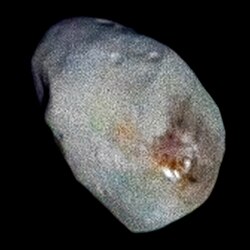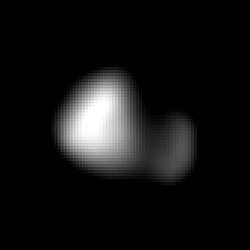
Moon of Pluto · Kuiper Belt

Styx

The smallest known moon of Pluto, a highly elongated body orbiting just beyond Charon.

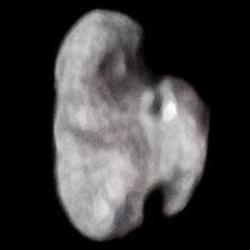
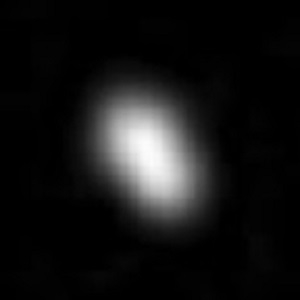
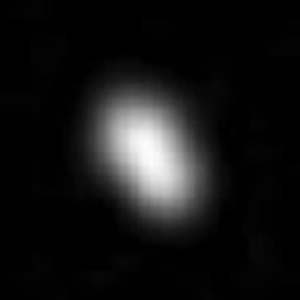
New Horizons view of Styx
NASA / Johns Hopkins APL / Southwest Research Institute — New Horizons.
Discovered2012
Dimensions≈ 7 × 5 km
Orbital period20.16 days
ShapeHighly elongated

The innermost small moon

Styx is the smallest of Pluto’s five known moons. It was discovered in 2012 with the Hubble Space Telescope during observations that helped assess the Pluto system before New Horizons arrived. Its orbit lies just beyond Charon and inside the orbit of Nix.

New Horizons resolved Styx as a highly elongated body. Studies of the Pluto system’s dynamics suggest that its rotation may be complex rather than simply tidally locked.
A clue to the system’s architecture

Even though New Horizons could resolve only limited surface detail on Styx, its orbit and shape help scientists study how Pluto’s compact satellite system formed and evolved. The leading idea is that the moons formed from debris produced by an ancient collision involving Pluto and another Kuiper Belt object.

NASA’s New Horizons mission made the first close reconnaissance of the Pluto system in July 2015.
Interactive visualization

Explore the Pluto system in 3D

NASA’s Eyes on the Solar System places Pluto in its wider solar system setting and lets you examine the Pluto–Charon system in three dimensions. Rotate the view, zoom in or out, and use the time controls to follow the modeled motion of the system.

NASA Eyes on the Solar SystemPluto system — Styx
Current time: Open full screen ↗
Mouse / touch orbit and inspect Scroll / pinch zoom Time controls rewind or fast-forward Full screen best on tablets and phones

NASA Eyes is an interactive visualization provided by NASA/JPL and loads from eyes.nasa.gov. If the embedded view is unavailable, use the full-screen link above.

The Pluto system

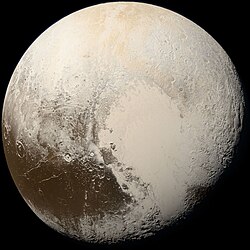
Pluto and its five moons

Pluto has five known moons. Charon is by far the largest and forms a closely coupled pair with Pluto. Farther out, the four much smaller moons—Styx, Nix, Kerberos and Hydra—follow nearly circular orbits around the Pluto–Charon system.

Keep exploring

Continue exploring

NASA Science provides mission background, observations and image collections; Wikipedia offers a broader reference overview with citations.